A night in Buenos Aires, Missouri
About 20 minutes into the Argentina vs. Algeria match, I had to get out.
It wasn’t claustrophobia for being packed into the Arrowhead pressbox like sardines with what I’d estimate to be 300-plus journalists from around the world.
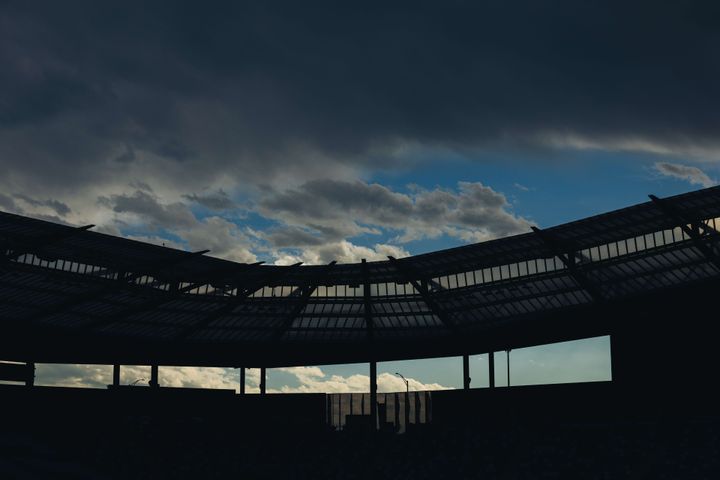
The sounds that filtered through the thick glass were evidence that Tuesday night would be unlike any other at Kansas City (Arrowhead) Stadium.
“Muchachos, ahora nos volvimos a ilusionar…” was the song reverberating out of Arrowhead that hit me the moment I stepped out of the elevators and through the glass door on the eighth level. I stood on the concourse for almost the rest of the match.
Roars for yet another magical moment from their hero were followed by the worship of what felt like 65,000 Argentinians.
“Messi! Messi! Messi!” as they bowed towards the greatest to ever do it. By the end, whether in the famed blue-and-white stripes or with the Algerian flag on their backs, all 69,045 fans in attendance paid their respects.
And then they celebrated long, long after the final whistle. The most popular and repetitive choice, “Soy argentino, es un sentimiento, no puedo parar!”
Even the Algerians felt Argentine after the match.
There are images that, thankfully, are permanently burned in my brain.
The first emotion of Messi after his first goal. We’ve since learned Messi’s father is hospitalized this week, and while doing well, that is difficult to handle as you are about to lock in on one final journey.
After Messi’s third goal, Arrowhead broke out into “Soy Argentino” yet again. I turned around behind me, and there it was: a father and his young son. The boy sat on his dad’s lap, and the two had whipped their shirts off and twirled them around their heads to the beat and rhythm of the song.
The man next to them had kept his on, but was pumping his fist up and outwards, as is the tradition for Argentinian soccer fans. The smile he had on his face, with tears in his eyes as he took in the sight, was priceless.
It undoubtedly was not priceless in the literal sense for those three to be in the stadium on Tuesday. The average ticket prices on resale markets were north of $600 as of my last check on Tuesday morning.
But for Argentinians, seeing Messi is always priceless. And to be dazzled by him in the fashion they were on Tuesday certainly gave them that feeling.
Soy Argentino
I couldn’t get the song out of my head…and frankly still can’t. I am not Argentine, nor is any of my family heritage Latino. But boy, does Argentine soccer mean a lot to me.
During an interview for my match story with an Argentinian from Mexico City, a tall man in a suit walked by us to the TV Mixed zone on the concourse.
“Martin! Martin! Vamos! Vamos!” the man yelled out to him mid-interview.
“He’s famous in Argentina!”
I know, I know!
I then explained. Back when I began watching soccer as a kid, it was nowhere to be found on American TV — at least in English. But if you knew where to look, you could get the game in Spanish. I still don’t know Spanish well enough to carry on a long conversation, but back then, that didn’t matter.
I just wanted to watch the game I loved. Channel 11 — Telemundo and Channel 23 — Univision could bring me Liga MX on cable TV. I watched El Bofo and Cuauhtémoc Blanco at Chivas somewhat regularly. Channel 72 was in Portuguese, so I took in my share of Benfica and FC Porto. But Channel 43 was the best: Fox Sports en Español.
They showed me plenty of Boca Juniors. And I fell in love. The odd design of La Bombonera, the fanatical support of the Xeneizes, and the insane atmosphere drew me in. It was a visually absurd scene of soccer support that surpassed anything I had seen or experienced.
I knew Boca and River were bigger rivals than the Yankees and Red Sox. And that, I knew before I knew Real Madrid and Barcelona, or even understood Manchester United and Liverpool.
I remember watching the last minutes against Bolívar in 2004 as Boca lifted the Sudamericana trophy at La Bombonera. Then again, defeating Pumas from Mexico on penalties after the second leg to lift the trophy again in 2005. Pato Abbondanzieri was the hero that night.
But then came Boca’s run in the 2007 Copa Libertadores. Martin Palermo, Rodrigo Palacio, Juan Roman Riquelme, Fernando Gago, and, of course, Abbondanzieri. I had honed in on playing as a goalkeeper at that point, and boy, was Pato a legend for me.
I watched every match of their knockout run to lift the Libertadores. I was a nervous wreck for the quarterfinals after losing 3-1 to Cucúta, before turning it around for a 3-0 second leg victory at a foggy La Bombonera. I rushed home from church on a Wednesday night just to watch the final half and see the scenes at the final whistle.
Boca Juniors were there for me when the San Jose Earthquakes were ripped from my region and taken to Houston, where they won trophies I should’ve been able to witness and celebrate in my childhood.
So, as the Argentines at Arrowhead showed Kansas City what unbridled passion and borderline obsessive worship of their soccer team looked like, I knew what was coming. And I understood it.
¿Soy Argentino? No.
No soy argentino. Pero es un sentimiento que puedo comprender.
I am not Argentine. But it’s a feeling I can understand.
Comments ()